When we were back at the Meadow – and I was a hobby farmer – I had to learn how to cull chickens. It was not so we could eat them. As soon as I named them – and I did – they were no longer destined for any table. It was not an easy thing to learn. Nor ever an easy thing to do. It was made all that more precarious by this story.
Mike the Headless Chicken … yes … you read that correctly. Mike was a famous rooster (back in 1945) who lived eighteen months without a head! Apologies … I almost resisted sharing his picture…
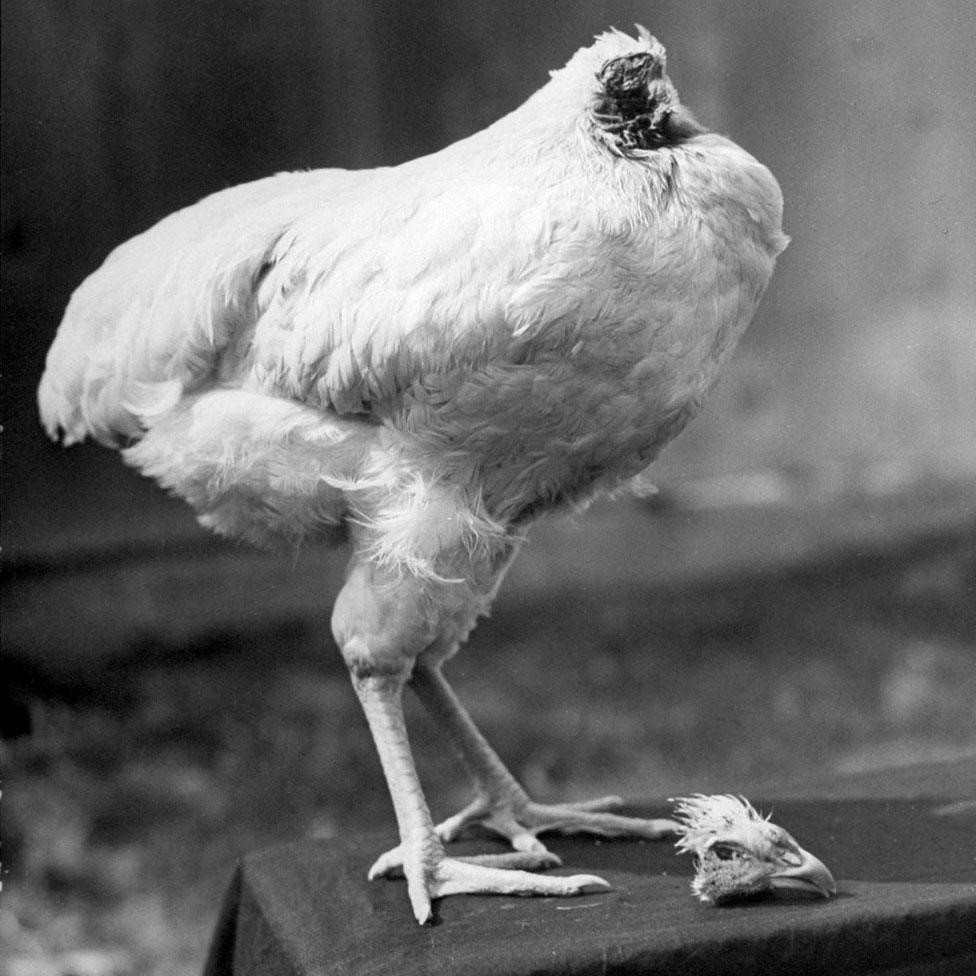
This was due to a botched butchering attempt. There are SO MANY QUESTIONS I would ask Farmer Lloyd who screwed up and missed his target with his axe. First being – why didn’t you finish the job?!? Mike ended up making the rounds of summer fairs. They fed him through his exposed esophagus. Yikes! He lived until he choked … Eighteen months! He lived because he retained most of his brain stem. The rest of his brain was not necessary for life…
As a student at Queen’s University one of my favourite courses was anatomy. It was fascinating to study real corpses (I know … that sounds worse in writing…) How strange to live in our bodies and normally not get a chance to see the incredible network of bones, veins, arteries, nerves, muscles, tendons… and organs. Especially the brain! I am so glad I had that opportunity!
The brain had as much to commit to memory as the rest of the entire body. We might think of the brain as ‘THE’ brain … one thing. But it has many different functioning parts. Some of which are visibly different from one another.
The brain stem sits at the base of the skull, right above the spinal cord. It keeps our body alive by regulating breathing, digestion, and blood pressure without conscious thought. These are our autonomic systems. I think that word would have been simpler if they just said ‘automatic’ systems.
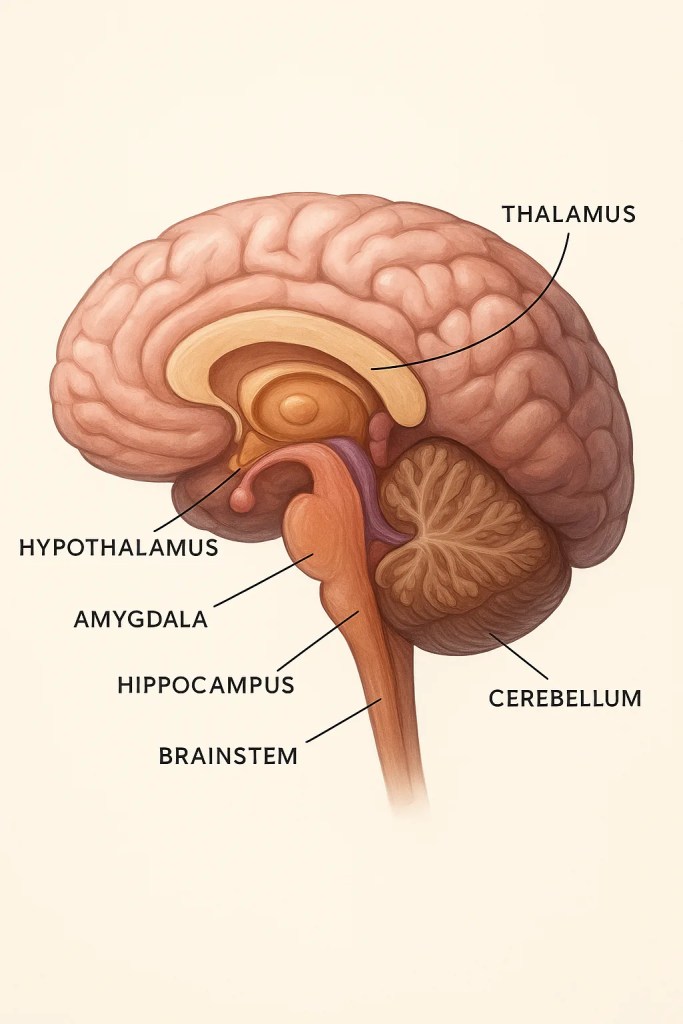
Sitting just on top of the brain stem is the hypothalamus. It is small. Think of a small grape or an almond. But it plays an important function. This part of the brain undergoes significant degeneration and structural changes in Parkinson’s Disease. This little ‘grape’ in my ‘noggin’ is wreaking havoc in my life.
The hypothalamus gets plugged up with Lewy Bodies. It is this part of the brain that causes much of the non-motor challenges of Parkinson’s Disease.
My current challenge is that my sleep-wake cycle is totally out of whack. I just got out of bed to put my ‘awake’ brain to use. It is 3 am!
At 9 pm I turned off my light and curled up to let my tiredness melt into sleep. Some nights that is easy to do. Many nights – hmmm – not so much. So … after resting, visualizing my favourite places, listening to a podcast, writing books in my head, turning and turning again, listening to the wind and the waves on the shore… I finally just got up. My brain is fully awake! I’ll make ‘hay while the … moon… shines’.
Of course … the flip side of this is I may fall asleep DURING the day. For many hours. This night time wakefulness does not always translate into daytime sleepiness. Sometimes the ‘high’ lasts well through the day to the next night. Sometimes I get a good night’s sleep and still need a two or three hour snooze in the afternoon. My hypothalamus is struggling to maintain any kind of sleep – wake cycle.
A friend who is also a retired doctor sent me some interesting news last week. The hypothalamus produces orexin. It is a molecule that neurons in our brain use to communicate with each other. It sends strong ‘stay awake’ signals to the rest of the brain. New research is indicating that the use of insomnia medications can help the Parkinson’s brain turn down this overactive arousal. THAT would be such a relief!
That little grape is also contributing to incredible sweating … People around me can be putting on long sleeved shirts and I will be embarrassingly soaked. Not a hot flash. Those have long gone. This sweating is more a ‘surface problem’ than the interior waves of heat from a hot flash. I have played entire soccer games (admittedly long in the past) and worked up less of a sweat. It runs down my face. It soaks my hair. It seeps into my shirts – even soaks my shorts! It can make me feel quite silly for the highly unusual flow of water coming out of my body. No exercise or stress required. Just a faulty switch – gummed up with Lewy Bodies.
That little hypothalamus triggers our hunger and thirst – or not if it is malfunctioning. Most days I have to deliberately MAKE myself drink. Thirst can be blunted by Parkinson’s. Being dehydrated can quickly worsen cognitive and motor symptoms. So I carry a glass of water and try to be patient when Ede reminds me to drink.
The hypothalamus also regulates our emotions. It triggers our ‘fight or flight’ response. It triggers anger and aggression. When my Parkinson’s had progressed beyond what my levodopa could fix I noticed this. I noticed it enough to sit down with Ede to say “I am SO angry… all of the time…” That was out of character for me. I wasn’t angry with her. It was a generalized state of being. I realized I was stewing in anger. Instead of ‘having a cold’ I was having ‘an anger’…
I did not like sitting still with that emotion. My mind would find things I could be angry with … and after musing about them I would be.
I was angry for a long time … maybe months. Non-assigned anger. When my levodopa doses increased the anger was gone. Very strange experience.
Sitting atop the hypothalamus is the thalamus. The thalamus looks like two egg shaped masses. It has the job of sending signals from the brain to the muscles to create smooth, purposeful movements. That is something that gets affected early on with Parkinson’s / Lewy Body Dementia.
For me that began as stiff legs. Initially I thought I must have ‘overdone’ it … and the stiffness would go away with exercise. Gradually that transformed into feeling like my legs were cast in cement tubes. Levodopa does a good job of relieving this pain and stiffness. In the middle of the night, when I am farthest from my last dose, I need to stretch my legs regularly to keep them from becoming solid. The other way this showed up was ‘freezing’ of my legs. That was quite an interesting experience the first time I became aware of this. (I had quite a few falls before I clued in.) I stood up, ready to walk to the kitchen, looked down … and realized my legs could not – would not – move. I could see them, feel them, pinch them… but I could not make them move. They were holding me up. I was standing. Eventually I shuffled my way across the floor and then ‘click’ – just like a switch being flipped – everything was normal again. Weirdly normal.
The thalamus also regulates our general level of alertness. It helps you to prioritize what to focus on and what to ignore. It helps to control our level of consciousness. I struggle here as well. When these neurons are ‘off duty’ I feel like a walking zombie. I am awake, going about my day, but feel like it is actually the middle of the night. I am about as alert as I would be stumbling to the toilet in the dark – trying not to wake up too fully. It is a very strange feeling …
Another non-motor impact of a struggling thalamus is that it is difficult to learn things. Early on (four years ago when we were still at the Meadow) I was trying to learn to play ‘The Forever Now’. It is a hauntingly beautiful tune that I first heard on the TV series ‘This is Us’. I would work at it almost every day … And after six months I realized I just wasn’t going to be able to master this one. That was a first for me. I hadn’t known it had been SIX MONTHS until I was flipping through my ‘day book’… That was one of those ‘how strange?’ realizations.
Not being able to learn new music, or keep up with software changes, or read crochet or knitting patterns … this has been almost as difficult as having cement legs.
I can see in this diagram (below) and in my observations how the damage to my brain is reaching up through my brain stem.
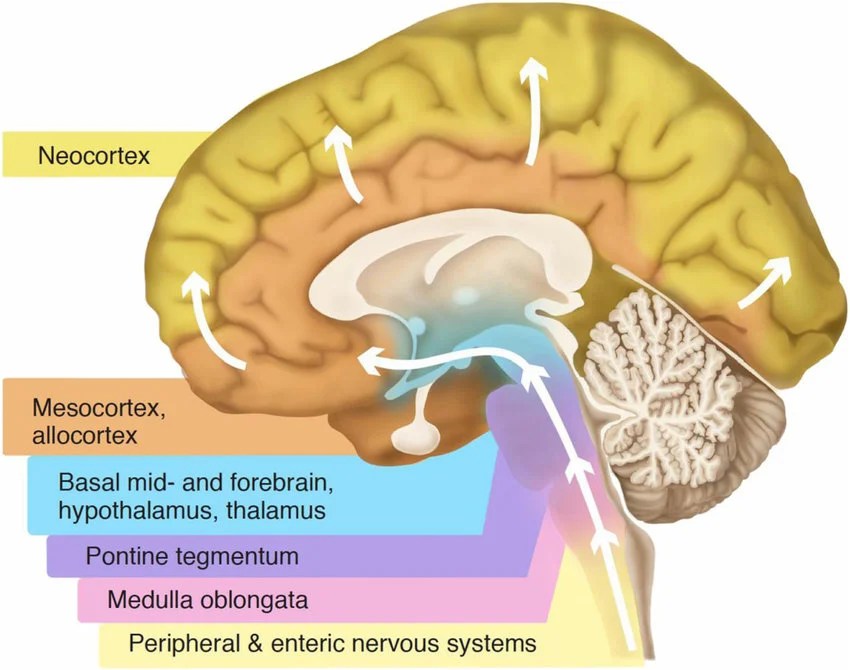
Where are they coming from? And how do they get to my brain?
There is plenty of research showing how Lewy Bodies affect the digestive system. And in fact for some they may began to accumulate there and then from there move to the brain through the vagus nerve. In the digestive tract they cause difficulties with constipation, a slow emptying of the stomach, and difficulties with swallowing. Again items that would get a ‘check’ on my list of symptoms.
Back to my anatomy classes … We routinely had exams in the Collections room. This room had samples of body parts suspended in glass cases. The staff would prepare the samples with tiny coloured flags . The test required us to name whatever was marked. You had 30 seconds at each case. Perhaps a 100 items to identify in total.
I have an excellent memory. I loved these tests. Except for the unit on the brain. Everything was soooo tiny. So complicated. The rest of the body seems downright mechanical compared to the brain.
Everything we do, feel, think… involves our brain. Whether we do it purposefully or automatically it flows through our brain. Parkinson’s Disease / Lewy Body Dementia can be different for each patient as our symptoms reflect which parts of the brain are affected. There are a LOT of parts to choose from.
Parkinson’s /Lewy Body Dementia patients are similar in that everyone has difficulties with muscle rigidity and balance. And everyone has a loss of dopamine producing cells in the brain. (Hence taking levodopa – which delivers dopamine to the brain – is a back door test to see if you might have Parkinson’s Disease.)
PD/LBD patients differ as the Lewy bodies affect different parts of their brains. Whatever the affected part of the brain controls manifests as symptoms. The rate of spread can vary greatly. And the severity and timing of non-motor symptoms can vary greatly.
It is the classic ‘freezing’ of your gait. The rigidity of the muscles. The slowness of your movements. These are common signs that doctors watch for. Then the non-motor signs are investigated. That is when you feel like you are inside the story of Mike – the headless chicken. You can do without your eyes, your ears, your mouth, and even most of your brain… But mess with that brain stem and the ‘thalamus brothers’ … there’s going to be trouble down the road.


Leave a comment